
Apocalypse Postponed/A View from the Iranian Diaspora—Part II/Art of Movement Building—Rude Mechanical Orchestra
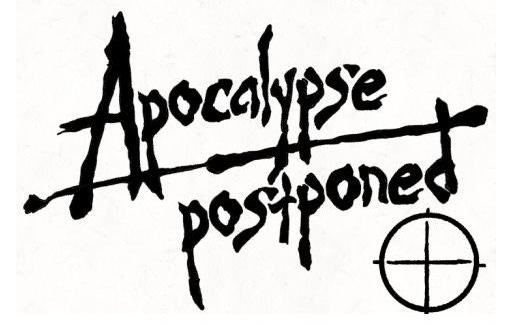
As New York and the world waited for Trump’s apocalyptic deadline delivered to Iran on April 7th and 8th, there were four rallies in the city against the threatened attacks. The protests were scattered and relatively small, as they were after the attacks on Iran began in February. But they continue.
“A whole civilization will die tonight, never to be brought back again,”Trump had posted. He had already threatened “to bring them back to the stone ages, where they belong” (echoing Vietnam-era pro-nuclear-war General Curtis LeMay), but then added that “one of the most important moments in world history could unfold that night,” if Iran did not give in to their demands. Even Pentagon figures were afraid of their staff being held liable for war crimes if they followed those orders. A growing number of GIs have been calling a 24 hour hot-line inquiring about applying for conscientious objector discharge.
As it turned out, that particular threat was just another instance of Trump’s “I’m unleashing Armadeddon, oops, not yet” incoherence. In the end, the threat was postponed for talks. Both sides sent a list of demands unacceptable to the other, in teams led by politicians, not negotiators. Predictably, the talks ended on Sunday, less than a day after they started, without an agreement. The Trump administration is caught in an unpopular war threatening economic catastrophe. Its postponements look aimed at calming markets, not bringing peace.
In this issue we continue the interview with Raha, a local Iranian-American woman who discusses differing viewpoints in the diaspora, and argues for a feminist view, opposing the present regime, and standing in solidarity with Palestine and against US intervention.
Similar voices have been heard nationally and here in New York, from NIAC (The National Iranian American Council) at its April 9th press conference in Brooklyn, and elsewhere. One Iranian speaker at the April 7th anti-war rally in Foley Square said there were many against the war (A NIAC poll shows 3/4 now opposed), but those supporting intervention still seem to dominate the press.
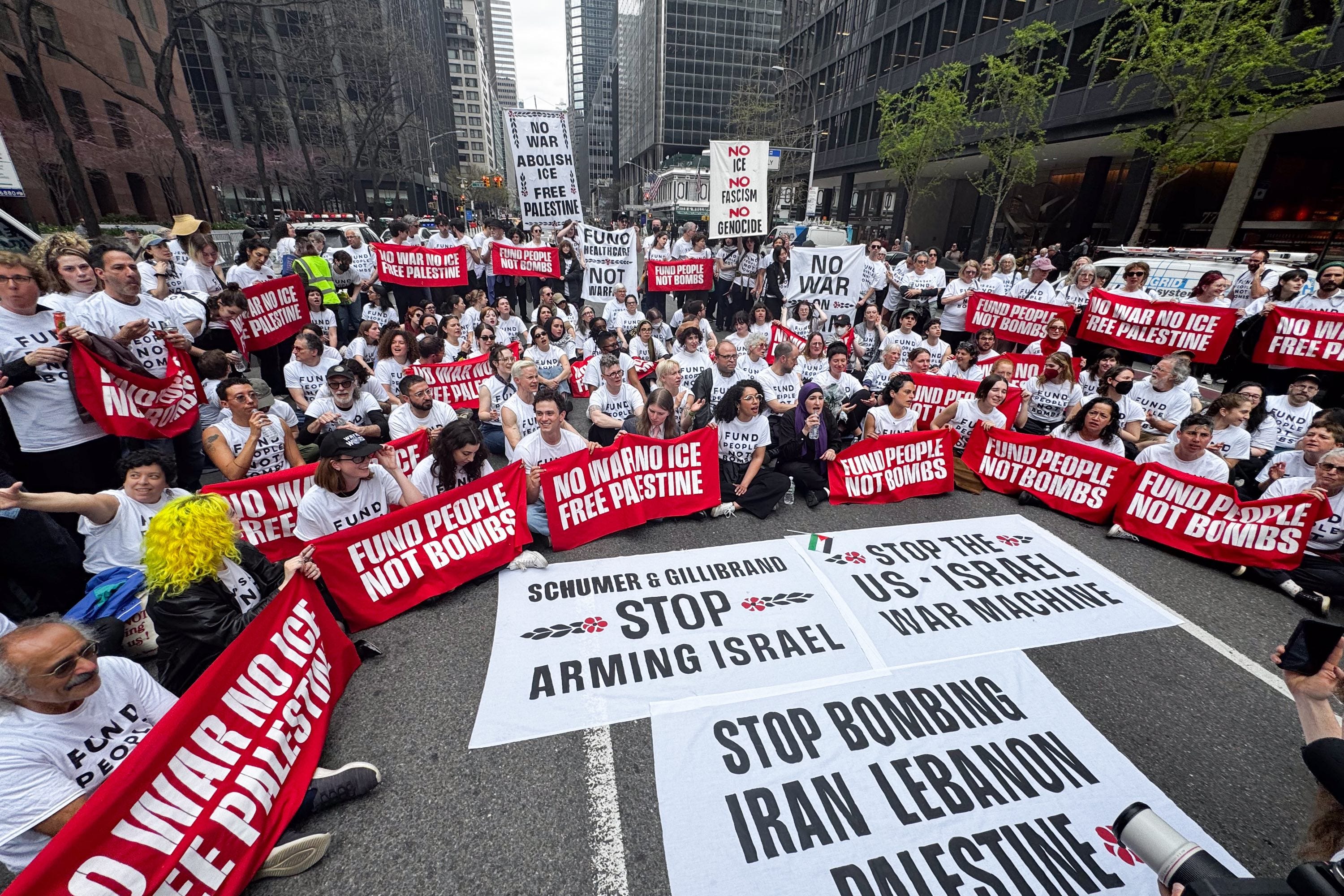
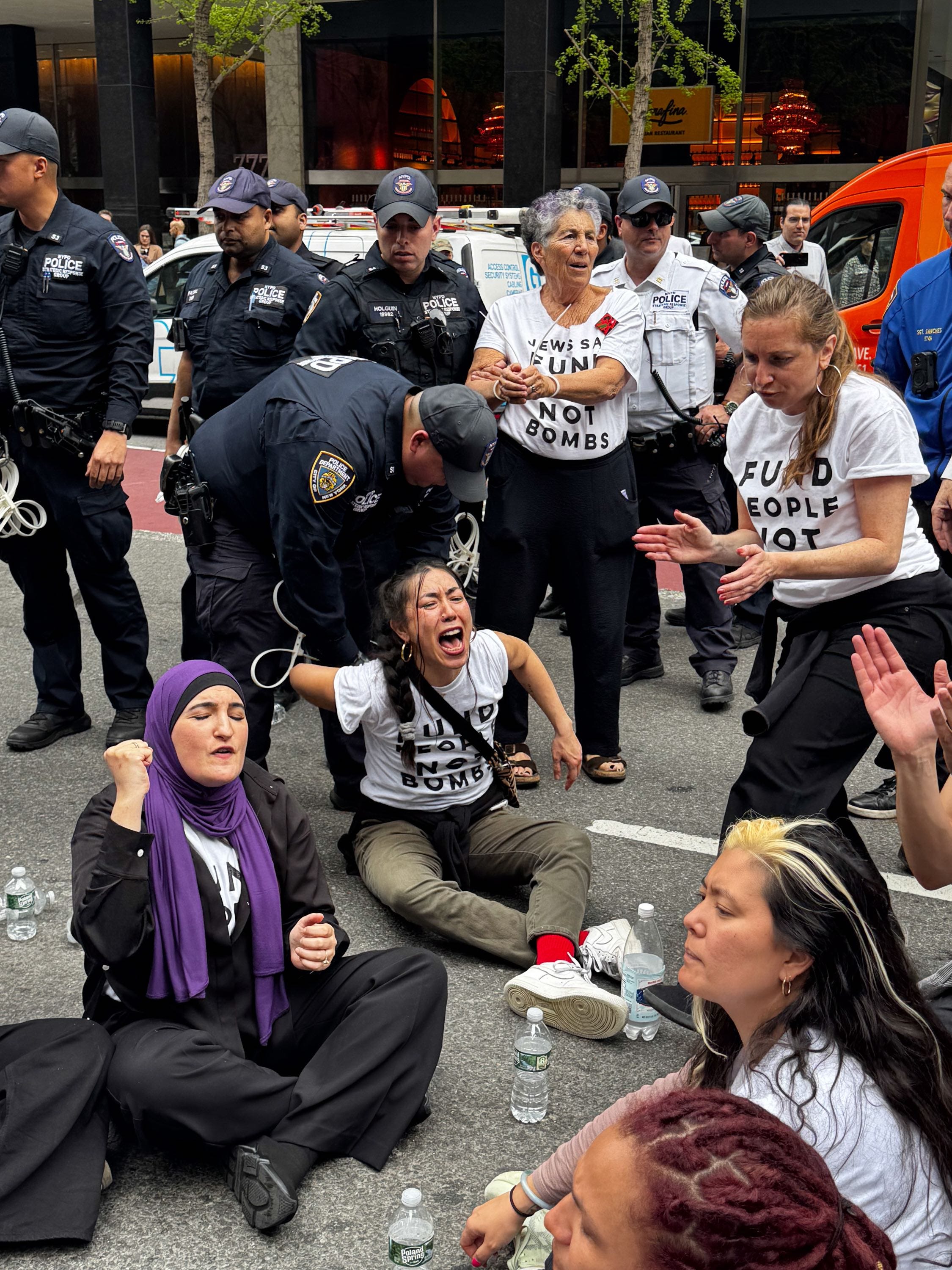
On Monday, April 13, hundreds gathered outside the office of Chuck Schumer and Kirsten Gillibrand against the US sending more bombs to Israel, in a protest led by Jewish Voice for Peace. Nearly 100 demonstrators were arrested while staging a sit-in, in opposition to the wars on Iran, Lebanon, and Gaza. This action followed the JVP-sponsored antiwar Seder in the Streets on April 8. On April 24th groups, including 5051, are planning a demonstration in Washington DC against war on Iran (Sign up to participate).
There were lots of anti-war signs at the earlier No Kings march, covered in our last issue, but it was still not a focus of that general anti-Trump event. The flood of local activism around defending immigrant communities is vital, but in an emergency situation, that work and a more visible anti-war mobilization should not be counterposed. A couple of us at Local Action found the April 7th rally at Foley Square promising. It was made up of many of those people involved in local groups who were also horrified by the threat of war and genocide. The speakers’ platform was not dominated either by organizations who uncritically support the Iranian regime or by liberal groups aligned with the Democrats. It seemed anyone could get up to speak.
The US-Iran cease-fire ends on April 22nd and no one knows where this conflict is going. We would hope this ongoing threat would move the various points of anti-war protest to a larger and united movement, with open democratic spaces to discuss politics and strategies, which can unite—despite other differences—around opposition to US war and intervention.
Anyone who has been to protests in this city will have had their spirits lifted by the green-clad radical marching band, the Rude Mechanical Orchestra. As part of our ongoing coverage of arts and organizing, we are glad to interview Sarah Blust of RMO about the music, activism, and community.
- Eric Fretz
A View from the Diaspora, Part II: Raha on Women/Feminism
This is Part II of our interview with Raha, an Iranian-American woman living in Brooklyn. You can find Part I in our previous issue.
Within the conversations among the women that you are still connected to, what’s the feeling now?
I think that the way folks outside of Iran view the treatment of women in Iran is really complicated. Historically the fascination with compulsory hijab has been, to many Iranian feminists in diaspora, not a useful, central conversation because it is often exoticizing and promotes a savior narrative. That savior narrative is often used to justify interventions like sanctions and war, which actually harm women and vulnerable groups.
Women in Iran are living within many different repressive structures that make mobilizing difficult. I think that is true in a patriarchal society anywhere on the globe. It feels silly but necessary to point out that women in Iran are often very highly educated and active in envisioning and pursuing change. There’s a term, “shir-zan,” that means lion woman, which Iranians have been able to use to describe women who have been outspoken during uprisings of the last several years. In January there were thousands of people killed by the regime. Mothers who lost their children to IRGC violence used mourning spaces to indirectly but passionately voice their fury. When videos were making it out of Iran many mothers and families in general were dancing at funerals, to show the regime they can’t control the people’s hearts.
Because of the Islamic Republic’s interpretation of religion, there are restrictive rules about daily life: women aren’t supposed to be unaccompanied out and about on their own … especially unmarried women. More pressing to my mind is how those daily restrictions demonstrate a larger repressive power dynamic. About three years ago, the Woman, Life, Freedom movement sparked initially from an encounter related to hijab. A young woman, Jina Mahsa Amini, was arrested by the morality police for allegedly not wearing her hijab “properly.” She was badly beaten and died in the hospital. Public outrage followed, which turned into weeks of uprising. The name Mahsa was the legal name we believe her family chose to be more palatable to the Islamic Republic for record keeping, but Jina was the name this young woman actually used, her Kurdish name. Jin, Jiyan, Azadî (the phrase, Woman, Life, Freedom) actually comes from Kurdish, and the Kurdish freedom movement. And Kurdish folks are often pointing out that this is not just a phrase that emerged spontaneously, it has roots in another set of struggles. …. Kurdish activists in the diaspora have been trying to raise consciousness that if you’re really trying to be in solidarity, don’t just say … Zan, Zendegī, Āzādī which would be the Farsi version, but say, Jin, Jiyan, Azadî, which is the Kurdish.
… After that, a lot of women stopped wearing hijab. It had long been that people were barely wearing it anyway, especially in the major metropolitan areas. Like a little bit of a scarf halfway over the back of the head. And then people just stopped. A lot of people stopped. Women were symbolically cutting off their hair at actions. Schoolgirls were singing freedom songs in schools. And the shift in hijab compliance remains, because I think the sentiment was, well, you’ve seen that we will have an uprising over the repressive ways that the Islamic Republic is trying to control the public and specifically women’s bodies. Yet even that has been a complicated situation for analysis—is this tolerance from the Islamic Republic meant to deter further uprising? Is it a symbolic win for the people, or a real indication of people power? At that moment the sentiment seemed to be, maybe people have shown that they can’t be repressed so severely because they are willing to risk death, and the Islamic Republic can’t kill a whole generation of young people who are speaking out.
The new uprisings in January of this year saw thousands of people in the streets, labor strikes, closed bazaars. This time it did seem as if the IRI was willing to kill a whole generation. There was enormous violence, internet shutdowns, and still unclear numbers of people murdered by the regime.
Since the war started in February, it’s difficult to understand what’s really happening.
The group of folks that I organized with and am still in community with—we’ve often said that war can never be feminist. War can never be a liberatory tool for a women’s movement. More often [it] makes the lives of women much harder. Sanctions have made the lives of women much harder because the economic sanctions on Iran made it much more difficult to get medicine. Made it really expensive to get household goods. And if women are maintaining the household, which is not everybody, sure, but similar to the US where, oftentimes, women do much of the labor of household work—sanctions and war make that much more difficult. Though many hoped otherwise, it’s been clear to me and other anti-war feminists from the start of this war that the well-being of the people of Iran is not motivating the US or Israel—they haven’t even used that framing in the many sham justifications named so far.
I think in the January uprisings and in the early days of the current war, folks both in Iran and in the rest of the world were really focused on the big picture because it felt like that could shape what happens more locally. The culture of surveillance and presence of state forces in daily life is so limiting to people’s mobilizing. In that way structural change was understandably a big goal for a lot of people, and led people to the desperate situation in which some people welcomed war.
Feminist Spaces in Iran
… I think with what happened after Jina Mahsa Amini, like, “You guys are supposed to be wearing hijab, but, if you’re not, I don’t know, just try to make it look a little like you are,”
I think there’s been this interesting space where people have been negotiating how much can they push on what is expected? And if enough of us are doing something, does that become the new norm? War does not encourage those kinds of generative, creative moments, though.
What [do] feminist spaces look like in Iran? This is also true in the States—I don’t know that everybody calling themselves feminists means the same thing.There are some groups who, I think, are explicitly feminist. There are people in Evin Prison who were leaders of those groups. Outside of Iran, there are affinity groups … established after what happened to Jina Mahsa Amini. There’s a group called Feminists for Jina, which is an international coalition. That group is mobilizing in a way where they are trying to talk about liberation and what it looks like for Iran, but centering feminist values. Maybe not so much the treatment of women, but feminist values, I think, is the thing that feels more accurate there.
So what does it mean to be a feminist? For the group that I was part of, liberation coming from below was one of our primary guiding principles. … I think there’s maybe a lens on political ideologies that can lead us towards “people-focused liberation”, more so than the sort of pink-washing that has happened in other kinds of geopolitical movements. Israel likes to claim that they’re really great about queer rights and the rest of the Middle East is so backwards. And therefore they are the best democracy, the only democracy in the Middle East, while (they are) bombing and displacing queer Palestinians. The feminists I’m in community with have long had solidarity with Palestine, and also experienced harsh criticism from other diasporic Iranians who see Israel as an opposition force to the Islamic Republic and solidarity with Palestine as therefore a kind of alignment with the regime. The inability to hold nuance, to be able to oppose all oppressive actors at once, has been a real limitation to organizing in the Iranian diaspora.
There needs to be pushback against that kind of framing, that Israel is a justified balancing force, that state powers could intervene in Iran because of the “treatment of women.” Cause I don’t think that that is grounded in feminist principles actually. It needs to be that whatever happens should be led by people within Iran based on this concept of liberation coming from below and on principles that are based on justice and liberation in general.
… Things should be led by people from within Iran. That has been a hot topic in our diaspora. People have said, “Well, my aunt in Iran wants the shah’s exiled son Reza Pahlavi to come lead . … Well, my cousin in Iran wants the war.” It is difficult to speak with anyone in Iran lately due to the internet shutdown and monitoring of communications that do get through. It’s long been difficult to get a sense of what overall sentiments really are given public spaces are so monitored. So there’s been this sort of weaponizing of who truly knows the Iranian public and who truly knows what the Iranian public wants. I think that some of us in the more feminist-oriented diaspora have been trying to question that because no group of people is a monolith. And if you look at the United States, for example, technically based on voting, most people in this country wanted Trump to be our president. Does that mean I should want that because most people in this country wanted that? No. The desperation of the people who felt somehow marginalized, or disenchanted enough to vote for him does not make his platform based in justice.
Some of the pro-war diaspora has become more concerned, now seeing that civilian infrastructure is being targeted in Iran, knowing that military precision is possible and so this destruction is due to deliberate choices. Some still hold out hope that the regime can be weakened and if the war has done this damage, it should continue until full regime change is imminent, so the suffering was for a greater good. For feminists in the diaspora, we feel horrified that the people of Iran and Lebanon are suffering as pawns for the Islamic Republic and for the US and Israel. There should be autonomy for the Iranian people to choose their own leaders, choose their own future—which was already a major undertaking, now made extremely difficult under conditions of war.
- Raha with John Gordon and Paul Wasserman
The Art of Movement Building — Rude Mechanical Orchestra
Sarah Blust grew up in DC. As a teenager, she used to cut school to go to protests and marches; she felt she needed to show up on the street. At the marches, she was always drawn to the music. That’s where the energy was. She found it sustaining, cathartic.
Fast forward to 2004; Sarah’s living in New York City. The United States has invaded Iraq; there are huge protests all over the world. Fired up with recent inspiration from the WTO protests in Seattle and her recent apprenticeship with the Bread and Puppet Theater in Glover, Vermont, she goes to a meeting of the National Abortion and Reproductive Rights Action League (NARAL) that’s planning the March for Women’s Lives in Washington. She knows that there isn’t going to be any music at the protest so she raises her hand and says she wants to start a band to take some of that creative energy and bring it to the March for Women’s Lives. ………. Dead silence!
But after the meeting, someone approaches her and tells her she should talk to Michele Hardesty who is trying to start a band to participate in the protests against the Republican National Convention planned for that August in New York. They join forces and what will become the Rude Mechanical Orchestra is born.
“We were a motley mix of rusty players that hadn’t picked up a horn since high school and longtime street bandistas on leave from Hungry March Band or the Infernal Noise Brigade, blowing sour notes at the invading greedheads and serenading the rabble.” (RMO website)
Twenty-two years later, the band is still here, and their mission statement is direct and unflinching:
“The Rude Mechanical Orchestra is a radical protest marching band based in Lenapehoking, the unceded occupied land of the Lenape Nation, colonially known as the New York City area. We play music and provide chant support in the streets at protests, marches, rallies, direct actions, community events, and more for the revolution and all its intersecting avenues, including (but not limited to): feminism, immigrant rights, queer and trans liberation, labor, peace, equitable community self-determination, decolonization, and racial, social, economic, housing, and climate justice.” (RMO website)
I met with Sarah at the end of February to talk about the band: their beginnings, what makes them tick, what’s enabled them to stay together so long.
Sarah told me, “There was something about that time (2004) that germinated the band and others like us, such as the Brass Liberation Orchestra in Oakland, CA and the Good Trouble Brass Band in Somerville, MA. After that, how could you have a protest without music?” They felt they “needed to bring some sparkle, some beauty, some joy to the protest.”
If you’ve been to a few demonstrations in New York, chances are you’ve encountered RMO (as they’re known). And if you’re like me, when you hear the noisy, lively beat of their horns and drums, you gravitate towards them, because as Sarah says, that’s where the energy is. They’re usually right in the middle of the action, dressed in green and black, marching along, horns blaring, drums providing a beat for the march, not trying to stand out, not trying to be center stage. If you’re not paying attention, you might think they’re just banging their drums and blowing their horns to some unnameable beat. But if you listen closely, you’ll hear the strains of a song you might recognize: “Which Side Are You On?; Bella Ciao; African Marketplace; or lately, All You Fascists Bound to Lose”. All told RMO has an active playlist of over 70 songs and is constantly developing new ones. To stay current and connected, the band also occasionally learns pop songs that are of the moment and then gives them a political twist. Examples of this are Lady Gaga’s “Bad Romance”, which the band has played to highlight abuses of power within the US and “Pynk” by Janelle Monae, which the band plays to lift up reproductive justice.
When 2008 rolled around, the band decided they should join the protests against the Republican National Convention again. It was held in St. Paul, Minnesota — a long way for a band of over 20 people with almost no money. So they wrote a proposal to buy a school bus, pitched that they would transform it to run on veggie oil, and somehow raised enough money to buy a used bus from a church in Florida. RMO’s ambitious proposal also included a partnership with the Automotive High School in Williamsburg, in which the students would be the ones to convert the bus to run on vegetable oil in exchange for music lessons. Amazingly, this all worked (thanks Automotive High School!), and once the conversion was done, folks in RMO who had design and carpentry skills rebuilt the inside. They took out a bunch of the seats, built in some creative storage space, and off they went.
The Big Gay Bus (as it was affectionately called) triumphantly took the band all the way to St. Paul, stopping at restaurants and diners along the way to pick up used vegetable oil. RMO joined the protests at the RNC, which were both inspiring and terrifying, as the band was very close to being arrested and the Big Gay was almost confiscated. However, thanks to knowing their rights and having the support of local friends and fellow musicians, they made it out of St. Paul unscathed and back to Brooklyn. RMO had the bus for many years and used it for another national tour to the US Social Forum in Detroit, MI. Unfortunately, on this trip, the band picked up some bad veggie oil in Milwaukee (don’t get your veggie oil from a diner, too many french fries) and broke down in Cleveland. The picture below shows RMO getting Big Gay out of the middle of the road. Emergency work needed to be done on the bus, but in the end, everyone made it to USSF and the Big Gay made it home.
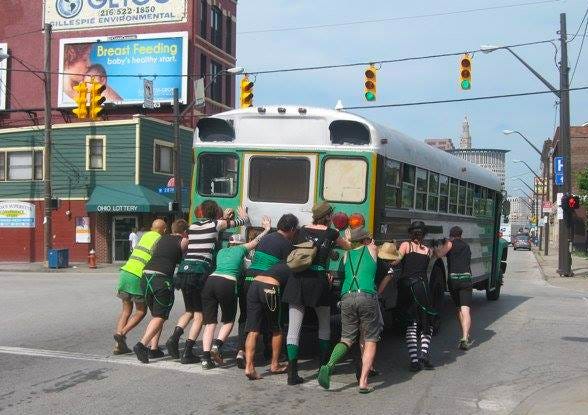
While the band loved its bus, parking it in Brooklyn became unsustainable. They used to park the bus on 3rd St in Brooklyn, right by the Gowanus Canal, across from where the Whole Foods is now. The bus was a bit of a mystery to people in the neighborhood; someone even started a Facebook page devoted to figuring out who owned it. Eventually, it just was getting too many tickets and the band gave it to a collective called VROOM, which loaned the bus out to community groups that could benefit from it, such as folks who needed to visit their incarcerated loved ones upstate. At this point, Sarah is unsure about where the bus is and would love any information about it!
When I asked Sarah how to account for their longevity, she talked about being in New York where there are so many people who care about social justice. But she also talked about how they work with each other in a way that supports investment and engagement: RMO is “consensus based. No leaders; but leadership! We try to hold space for leadership from women, from femme folks, trans people and people of color—people whose identities and communities have been marginalized.”
They also “have set up systems that have served us well. For example, we have a different facilitator for our practice each week. If you are a member, you are expected to lead a practice and a meeting.” They rotate that role by alphabetical order, which promotes leadership development and shared responsibility.
As much as anything else, RMO is a community.
(From the website again) “Since our founding, we’ve tripled our numbers and made strides in our sound, but we remain a band of mostly amateurs rediscovering and reinterpreting the music we played as adolescent band geeks and music-loving activists.”
As Sarah said:
“Because of our shared commitment to social justice and love of music, we have built deep friendships and relationships with each other. Babies have been born. People have become life partners and/or gotten married. We come together and create joy. Something about the process of our project and our band allows us to express our anger, to grieve, to celebrate and ultimately build human ties that have stood the test of time.”
- John Gordon with Sarah Blust
We hope that Local Action can be a vehicle to encourage collective action, help to break through the impotence and isolation many of us are feeling at this time, and contribute to building a community that makes the change we need.
If you want to find out more about Local Action, check out our About page. If you would like to contribute to future issues, please write to us at localactionnyc@gmail.com.
Local Action Team: Charlie Wertheimer, Ed Goldman, Eric Fretz, John Garvey, John Gordon, Judy Loebl, Paul Wasserman
Thanks for reading our Local Action! Subscribe for free to receive new posts and help build resistance to the authoritarian takeover of the country.
Such a pleasure to read some nuance about Iranian feminism and hear some spirited defiance music in this episode of Local Action. Keep 'em coming!