
May Day 2026!
May Day Actions in NYC and Elsewhere/It Doesn't Have to Be this Hard/Some May Day History/Deed Theft in Black Brooklyn/Working Class Tunes
May Day 2026 is shaping up to be one of the biggest May Days across the US since the 2006 Day Without an Immigrant. This year has been marked by growing anger at the Trump administration, triggered by economic anxiety, the threat of fascism, and the war on Iran. Perhaps most importantly, the massive ICE protests in Minneapolis have inspired people across the country to see the possibilities for collective action and to organize robust local mobilizations for May Day.
In our May Day Eve edition of Local Action, we seek to make our own contribution to catalyzing the 2026 May Day spirit. This includes a panoramic overview of planned May Day actions across the U.S. and in New York, and a look back at some of the deeper origins of May Day in the United States. In addition, we’re proud to present an interview with an activist with a mobility limitation discussing the challenges confronting disabled folks working on the front lines of today’s radical activism. We also have a brief report about recent anti-eviction mobilizations, with hopes of taking a deeper dive into this and other housing-related battles in future issues.
For this special May Day issue we feature a few appropriate tunes, some of which you may have heard before and others that may be new to you. Pete Seeger said “Get people to sing together and they’ll act together too.” So, let’s all try to sing together this May Day.
- Paul Wasserman
May Day Actions in NYC and Elsewhere
In New York, the main rally (called by the New York City Central Labor Council and New York Immigration Coalition, and backed by the May Day Strong coalition) will start in Washington Square Park at 4:00 p.m. and march to Foley Square.
There are other activities from pickets to picnics scheduled (many on the NYC May Day Strong website, and others not).
The People’s Forum and allied groups have called a separate rally for Union Square at 2:00 pm, which will march to the Washington Square rally at some point.
The Democratic Socialists of America (DSA) are working with Amazon workers for an action against Amazon, gathering at 8:30am and marching to Jeff Bezo’s penthouse.
Nationally, the May Day Strong coalition is calling for “No School. No Work. No Shopping” on May Day. That call, previously used in Minneapolis, has been picked up in other cities. Even though we don’t know of any union officially calling a strike, in several cities, schools will be closed. The Chicago Teacher’s Union, an initiator of May Day Strong, has won May 1 as a declared “Civic Day of Action,” with this and future May Days counted as a “teacher-directed professional development day,” allowing partial shut downs and student field trips.
In New York City, fears of breaking the Taylor Law, which prohibits strikes by government workers, have contributed to hesitancy by the UFT and other unions to participate in any activity calling for “no work.” But many activists are still heeding the message, and taking off work to attend. Some of those encouraging “no-work, no-school, no shopping” on May Day view this strategy as practice for broader actions of economic disruption that may be needed in the future.
There are also attempts by more conservative forces to join in May Day activities this year, but turn them into smaller scale “No Kings” marches, and ultimately steer “the resistance” into voting for Democrats in the mid-terms. Without making any arguments about voting here, we can still say it is not enough to defend a hated status quo, and not even an effective way of opposing Trump’s excess.
In our city, the working class—multi-racial, multi-gendered, immigrant and native— is the vast majority, even if it is not united and prepared to wield its collective strength. Minneapolis has reminded us that ‘an injury to one is an injury to all,’ and revived excitement and talk about political strikes. If this May Day is combined with open discussion afterwards about next steps, it could be a real step forward. If the weather complies, it could also be a fun day out.
- The Local Action Team
It Doesn’t Have to Be this Hard
In November 2023, a group of activists blocked Brooklyn’s Prospect Park West in front of Senator Schumer’s residence to protest US support for Israel’s destruction of Gaza. Truitt, a DSA activist, was among them. One by one, they started cuffing people and putting them in buses which would take them to One Police Plaza where they would be processed. All except Truitt.
We were like all outside Schumer’s house and they just didn’t arrest me. It was so weird. It was 30 people getting arrested or something that night. They [the police] just acted like I wasn’t there. And it actually made me really mad. I was like, wow, I just got discriminated against. I was pissed … we’re all sitting in the street … I [thought], no, I’m not gonna move. But then I [thought], this is just weird. I felt like I’m making it about me … so I just ended up moving.
Truitt is paraplegic; he uses a wheelchair for mobility.
Truitt’s experience of that November civil disobedience didn’t end there on the street. When people plan to get arrested, the organization collects information about those planning to get arrested and holds onto their things so they can be returned after their release. For Truitt that meant having to travel to the jail to get his stuff back. I couldn’t go home. I couldn’t leave. [Either] I had to go and … stay with jail support the whole time. Or … I had to go find the jail support people at the jail.
A few weeks later, at a similar protest in Manhattan, Truitt was arrested and had his hands zip-tied behind his back. But then, instead of being loaded into a paddy wagon along with his comrades, he was given a summons on the spot and released. He ended up with his picture in the NY Post, but was separated from his fellow activists.
Truitt has been active with DSA in New York since he moved here in 2021. We interviewed him recently at a cafe near his home in Brooklyn. Truitt grew up in a comfortable family in a conservative town in Virginia, but had no real articulated politics while growing up. He became paralyzed because of a serious car collision during his senior year in high school.
That’s why I think I became class conscious. And it wasn’t overnight; it was slowly but surely … because on one side, I saw the amount of resources that my parents had and how that was so beneficial to me. And then other people that I met that weren’t getting that. This wheelchair is like $5,000 … through insurance … There’s so many more disabled people that you just never see because they’re in those big black hospital chairs that weigh like 40 pounds … It’s a lot of work to push a chair like that … I’ve met people [stuck in walk- up apartments]. I used to play basketball with this girl … I couldn’t believe it was real. She lived in the second story of a NYCHA building that her mom had. Her mom had passed away and passed it down to her and she had broken her back. But it was like, I can’t afford to live anywhere else so I’m gonna stay in this NYCHA building. And she would drag herself and her chair up the NYCHA steps to get in and out.
The interview revealed how difficult it is to be an activist with a disability in NYC. The difficulties that Truitt has encountered are not only due to architectural barriers, but to attitudinal ones as well. Most “able-bodied” activists have no idea of the challenges faced by a mobility-impaired activist like Truitt.
I don’t think that people recognize how much energy and time that it takes for me to go through my normal day. It takes me so much more time and energy to do the things that they do pretty quickly and without thought. [For example] to go to a canvass or an event. It’s just exponentially more energy. And I feel like people don’t take that into consideration when they are thinking about asking me to do [things].
Another thing that organizers often don’t take into account is accessibility of events or activities. The canvassing app that many canvassers use—MiniVan—doesn’t have a feature that allows a user to select an accessible “turf.”
I’ve been told multiple times when asking to canvass that I could phone bank. And it’s like, dude, I know that I can [do] phone banking … obviously I understand I can use a phone. I don’t want to do that. I want to meet people door to door, talk to people. I think sometimes people don’t understand that giving me a [different] option that is accessible is not the same thing [as making an accommodation for an action I want to participate in].
Beyond responding to individual needs at the point when there is a challenge, a group like DSA should be proactive in preparing in advance. Truitt notes that as people register for an event, whether it’s a meeting or an action, there needs to be a way people with disabilities can register their specific needs beforehand.
On Action Network, there’s a box that says this is an accessible event. [It doesn’t say] if it’s not accessible. If [the organizers] don’t click that, there’s just no message. So you don’t know if it’s actually accessible. And I gotta text someone. It’s annoying like that. It makes me confront the reality that I’m disabled. DSA should be a safe place where you’re not dealing with that.
On the other hand, early on while living in Virginia, Truitt learned a lesson about inclusiveness and organizing that has stuck with him. “This is actually why I stayed in DSA.” Upon arriving at his first DSA meeting, he discovered the location was in a basement and not accessible. There was an elevator but it hadn’t been in regular use.
They went and figured out where to get the keys, got the elevator running and got me down into this meeting … they made sure it was accessible … even though they hadn’t done it [recently]. And then [they] made sure to pick an accessible bar that we went to after the meeting … It [had] a big impact on me because I was like, oh, [they] didn’t have to deal with this. ... It was just someone else understood that they needed to figure it out.
Currently, Truitt is part of the welcoming team for “DSA 101” and has thought about how a blind person who came to one of these meetings could have been more fully integrated. And he is considering introducing a resolution at the DSA Convention in NYC to deal with some of the issues around accessibility.
I think this is maybe an ironic thing to say, but I think that disabled people are better at being less egomaniacal and super ego-driven and overconfident. There’s a real problem with overconfidence. It’s like people think they know exactly what we need to do: ‘We just do this. And if you listen to me, we’ll be able to get this stuff done.’ It’s really frustrating. I don’t think it’s universal, but I think that [people with disabilities] are probably less likely to feel that if they were just in charge, they could figure this out.
Truitt reminds us that making our activist organizations more accessible and welcoming to people with mobility limitations and other disabilities will benefit us all. The voices of folks with disabilities not only deserve to be heard, but they bring a different perspective to our work.
- Judy Loebl and Ed Goldman in conversation with Truitt
Some May Day History
The First of May is International Workers’ Day, celebrated around the world as a day of working class solidarity. Although the origins of May Day trace back to militant 19th Century labor struggles in the United States, fear of May Day’s association with communism and socialism has led U.S. labor unions in the post-war years to largely shun May Day. Instead, they’ve focused on turning out their members and unfurling their banners at annual Labor Day parades. But in the late 19th and early 20th centuries, May Day in the U.S. was a demonstration of militance and a memorial to the people who in decades past had fought against the system of profit that we still live under.
On May 1, 1886, a nationwide strike began for an 8-hour workday. On May 3, police killed several striking workers at the McCormick Reaper Works factory in Chicago. In response, labor leaders, including well-known anarchists August Spies and Albert Parsons, called a rally for May 4th at Haymarket Square. As police moved to disperse the peaceful meeting, an unknown assailant threw a bomb into the police ranks. The bombing and subsequent shooting left over a dozen people dead (including seven police) and dozens more injured.
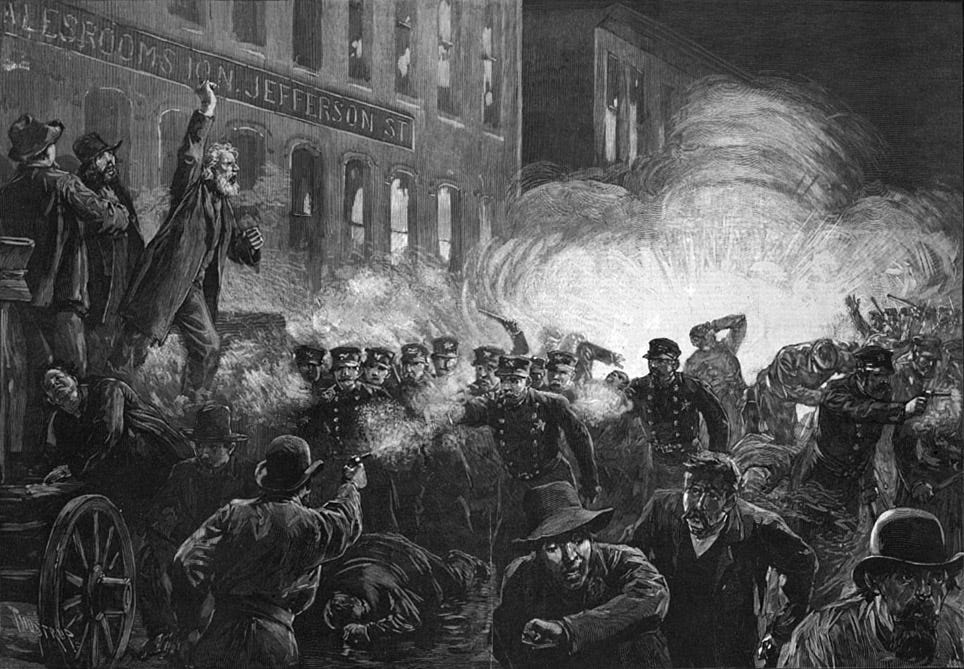
Eight men (most of whom did not throw the bomb and some who were not even at the rally) were convicted of conspiracy to commit murder. Four men were hanged in the following year. One other died by suicide in prison and three were pardoned. The bombing caused a setback for the labor movement due to anti-radical sentiment, but the executed men became martyrs, helping to inspire the creation of May Day as the International Workers’ Day.
While labor struggles were the immediate inspiration for the early May Day commemorations, the Civil War helped set the stage for the events in Chicago in 1886. Shortly after the Civil War ended, Karl Marx hailed the emancipation of the slaves and foretold an upsurge in labor activism:
Every independent movement for the workers was paralyzed so long as slavery disfigured a part of the Republic. Labor cannot emancipate itself in the white skin where in the black it is branded. But out of the death of slavery a new life at once arose. The first fruit of the Civil War was the eight hours’ agitation that ran with the seven-leagued boots of the locomotive from the Atlantic to the Pacific, from New England to California.
Those who were leading the demand for eight hours had seen the impossible become real. The government had made revolutionary changes in response to the heroism and sacrifice of the slaves. One of the leading abolitionists, Wendell Phillips, wrote in 1865 that “the next great question … is the rights of the laboring class” with the eight-hour day as the “first rule” for securing those rights.
Ira Steward, also an abolitionist and a leader of the eight-hour movement said that the eight-hour demand was a “first step” in reforming virtually everything. in a long list of next steps, he included “anti-pauperism … anti-monopoly, anti-prostitution [and] an end to waste, idleness, Woman’s endless drudgery and War.” A labor newspaper, the Daily Evening Voice argued that; “The laboring classes will never be elevated without the elevation of women.” (Thanks to the historian, Dave Roediger, for help in understanding the post-Civil War history.)
In New York City, late 19th and early 20th Century May Days were marked by numerous rallies and meetings, with various union halls and social spaces ringing with speeches in Yiddish, Italian, German, Finnish and many other languages to crowds mobilized by trade unions, anarchist and socialist groups. In the 1930s apartment houses in the Bronx and garment district sweatshops would empty as people flocked to Manhattan marches of tens of thousands held by both the Communist and Socialist parties.
In recent decades, a variety of activists and radical groups have tried to revive that militant May Day tradition, with mixed success. Notably, the 2006 Day Without an Immigrant brought out hundreds of thousands into the streets and shut down businesses from small immigrant-run shops to huge Tyson meat processing plants, all without any official union strike. On May Day 2012 in New York, the reputation of Occupy Wall Street brought the fractured left and several more mainstream unions into one exciting march down Broadway, culminating in a mass twilight general assembly downtown. Given the scale of this year’s nationwide resistance to ICE, the massive No Kings marches, and powerful labor actions such as the hospital nurses strike in New York, May Day 2026 may mark a promising return to the militant spirit of May Days past.
- John Garvey and Eric Fretz
Stop Deed Theft in Black Brooklyn
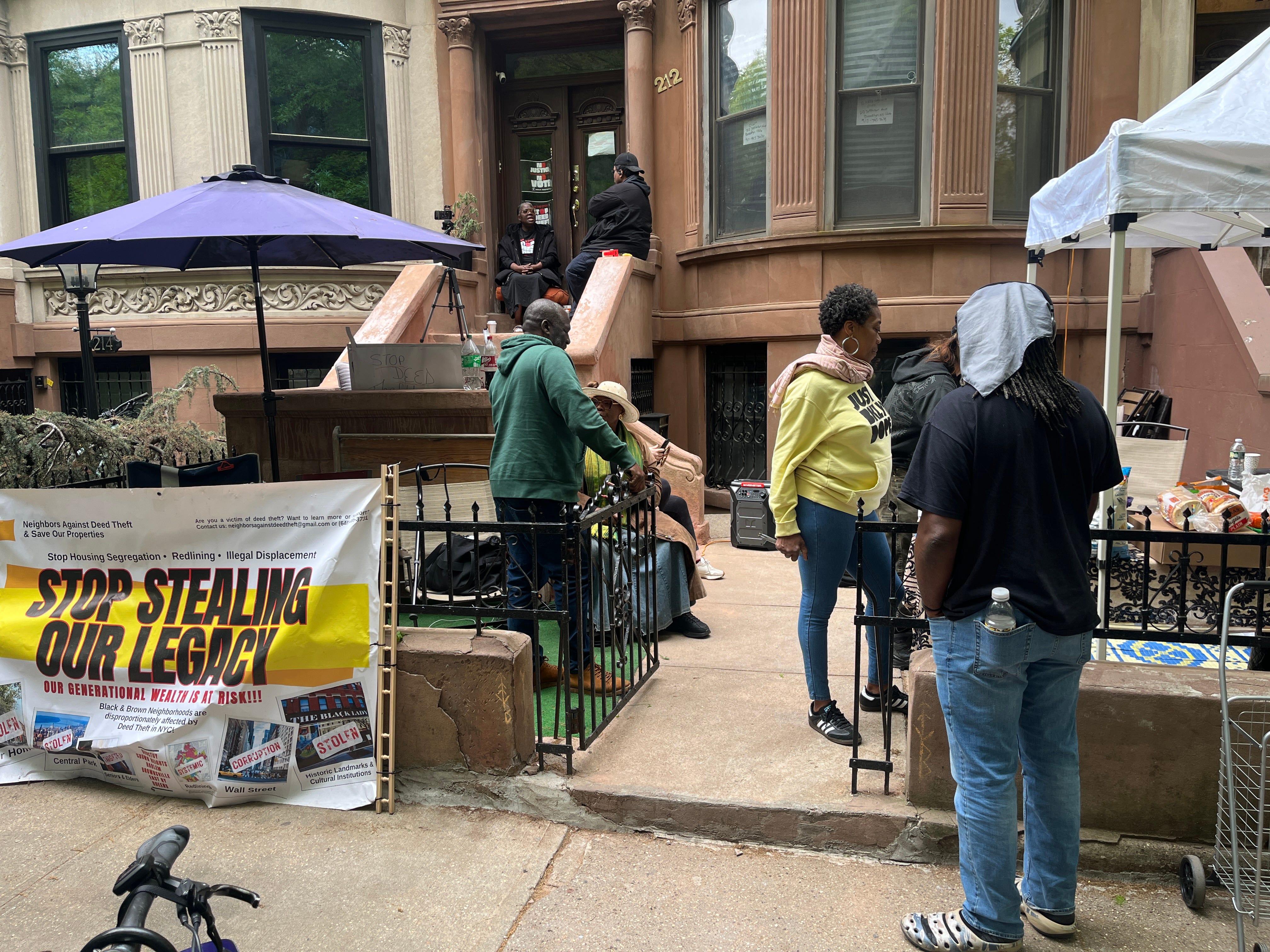
The long simmering crisis over deed theft in Black Brooklyn burst into the headlines last week when the sheriff’s office arrived at 212 Jefferson Ave in Bedford Stuyvesant to evict Carmella Charrington from her home. A large group of neighbors, including Councilmember Chi Osse, arrived to prevent the eviction. In the confrontation that followed Osse was thrown to the ground and arrested along with three others by NYPD officers. The eviction attempt that day was thwarted and since then neighbors and community activists have been camping out at Charrington’s home 24/7. You can find them on Instagram here.
Deed theft and other related shady practices have stripped hundreds of mostly Black and brown residents of homes that quite often have been in their families for generations. The practice has been particularly widespread in gentrifying neighborhoods like Bed Stuy. You can read more about deed theft here in The City.
A couple of us from Local Action went by the house on April 28th to offer our support We encourage you to get over to 212 Jefferson Ave to show your support and help build opposition to deed theft and evictions in our community!
- John Gordon
We hope that Local Action can be a vehicle to encourage collective action, help to break through the impotence and isolation many of us are feeling at this time, and contribute to building a community that makes the change we need.
If you want to find out more about Local Action, check out our About page. If you would like to contribute to future issues, please write to us at localactionnyc@gmail.com.
Local Action Team: Charlie Wertheimer, Ed Goldman, Eric Fretz, John Garvey, John Gordon, Judy Loebl, Paul Wasserman
Thanks for reading our Local Action! Subscribe for free to receive new posts and help build resistance to the authoritarian takeover of the country.
Thanks so much for this May Day 2026 edition of Local Action with a special shout out to Truitt! I feel more positive and upbeat about the future and the possibilities after reading this.
Laurene Clark