
Movement Building Takes Many Forms
May Day March/Park Slope Food Coop to Vote on Boycott/Community Faces Off with ICE and NYPD at Wyckoff Hospital/Art of Movement Building—Paul Stein/BPL Mounts "The Warehouse" at Bedford Library
Thousands of New York workers rallied and marched on May Day in Manhattan against war and the immiseration of working people; food coop members in Park Slope are getting ready to vote on boycotting products from Israel; community residents turned out to protest when ICE abducted a Nigerian immigrant in Bushwick with the support of the NYPD; and, through it all, artists kept on making art.
On the New York City May Day March
On May 1st, I joined with thousands in a focused and energetic march, one of the largest May Day gatherings in NYC in some time.
After several smaller actions earlier in the day, official union contingents mixed with many others gathering in Washington Square Park from 4 pm. Union speakers, immigrant rights groups, and Mayor Mamdani spoke to the crowd. Perhaps 20 thousand left the park to march down Broadway to Foley Square. If the (much larger) No Kings marches sometimes seemed like a stroll through the city, with clever, humorous, home-made signs, I felt this May Day had a more determined feel. It also was a more self-consciously working class demonstration, but that did not mean it was limited to bread-and-butter issues.
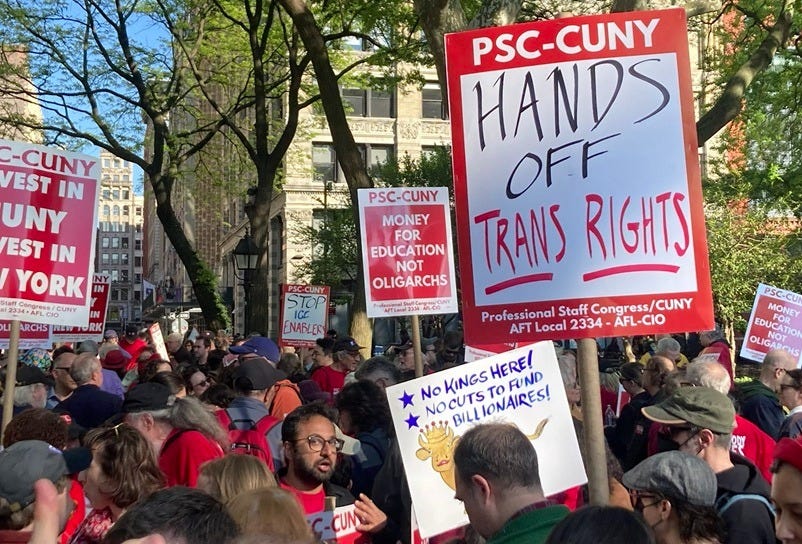
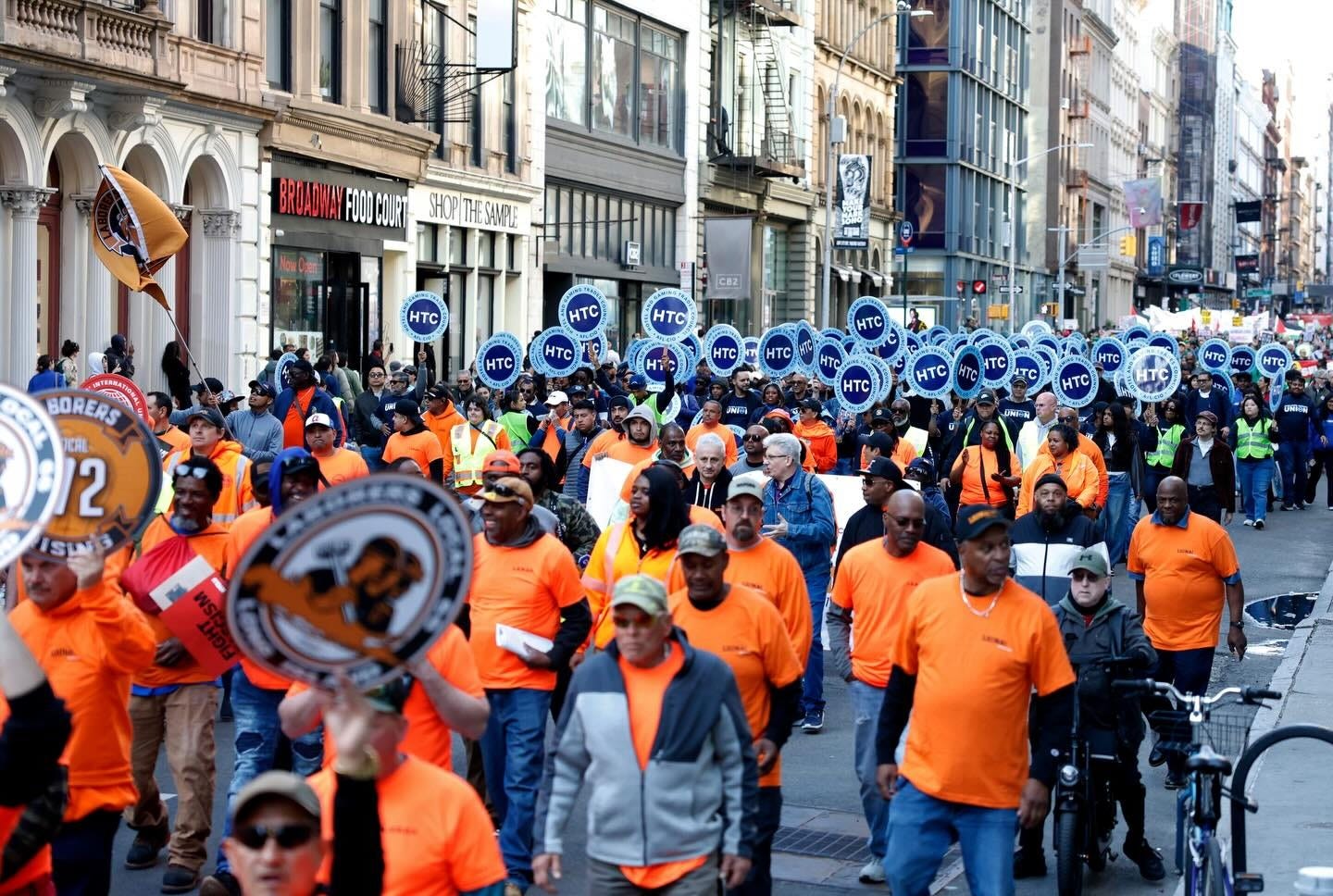
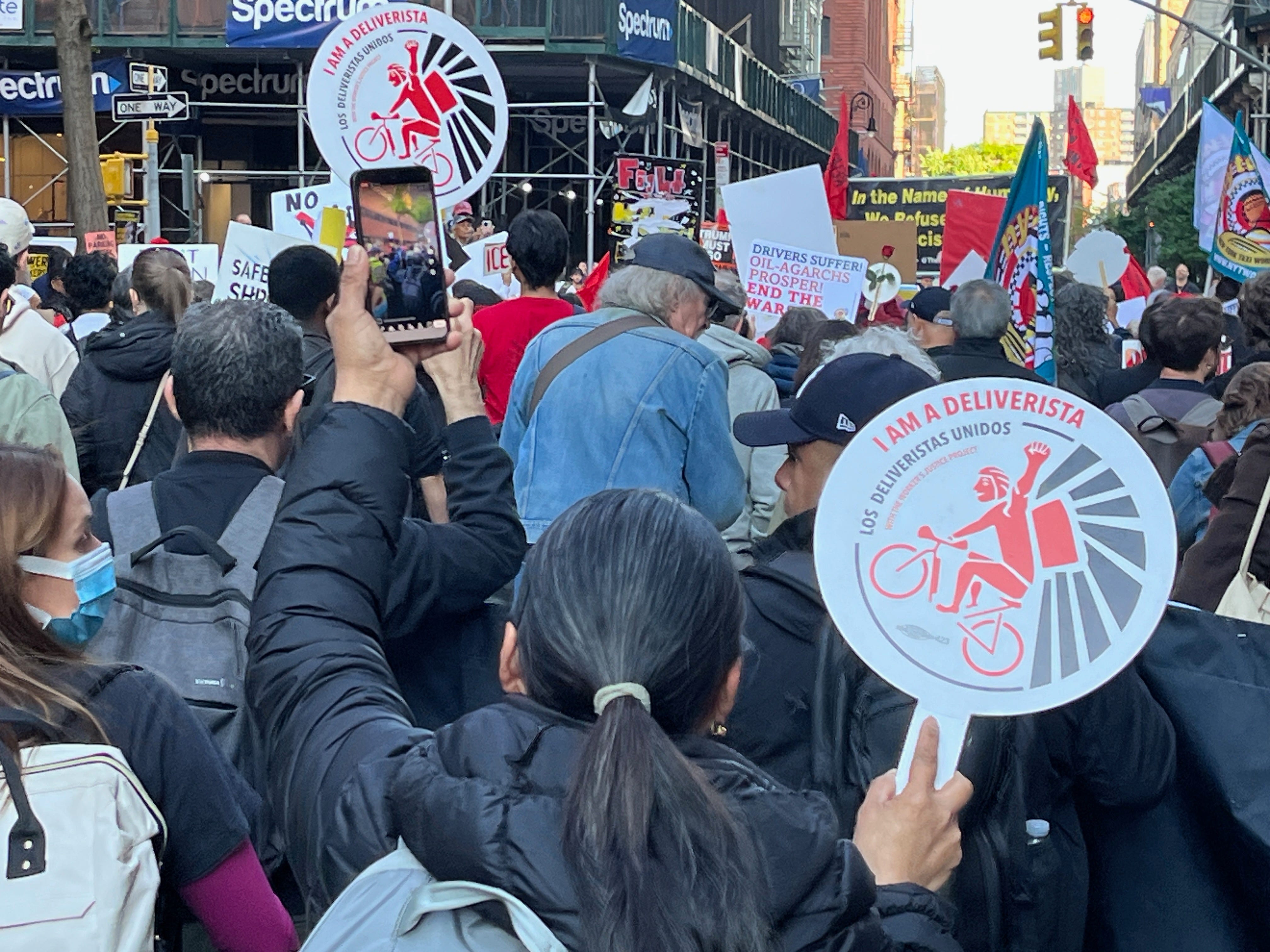
The Professional Staff Congress of CUNY brought out a large contingent, many in red, holding signs and chanting on a range of issues from local funding to ICE, Palestine, and the war on Iran. Visible contingents from the LIUNA (laborers’ union) locals, 1199, 32BJ, and the hotel workers in HTC, as well as more grassroots workers’ groups like the Laundry Workers Center, the Taxi Workers’ Alliance, and deliveristas with the Workers’ Justice Center were present. Together they brought significant numbers of black and immigrant workers, helping to diversify the march. These were interspersed with various left groups, community organizations and individuals, many younger. This was overall a much younger crowd than the No Kings marches.
It was unusual to have the New York City Central Labor Council (AFL/CIO) endorse a May Day march. True, turnout was not huge compared to the size of the unions. DC 37 had a small group of staff mixed with current and retired workers, and several large unions had little if any presence. But overall there was a bigger turnout of workers than we usually see, and it seemed something new to see labor executives speaking to a crowd peppered with Palestinian flags.
The huge protest in Minneapolis on January 23rd was a great inspiration. There, building on impressive community mobilizations against ICE, we saw a significant increase in union locals involved, and a huge number of people taking off work on the day. The closure of businesses large and small in Minneapolis, despite few if any actual strike votes, helped raise discussion of political strikes.
Though there was aspirational talk of a “general strike” in some unofficial publicity for May Day, this was never in the cards. A few days before the event, a newer activist asked me how to prepare for “the general strike they are planning.” It is good that this is part of the conversation, but loose calls for a “general strike May 1st” can also be counterproductive. For one, naive expectation could lead people to disappointment. Also, it would be a shame if newer activists reduced their idea of a general strike to a workday demonstration with individuals taking a day off. But if greater levels of workplace militancy are used as an aspiration to build towards rather than a yardstick for this event, it can help discussions about where to go from here.
The US has seen city-wide general strikes before, like the unplanned Oakland strike of 1946 or notably Seattle in 1919. There, 65,000 workers shut down the city in support of striking dock workers, delegates from 110 unions voted on exemptions for critical services, and communal union canteens fed the people.
While on a small scale, a few unions did manage official strikes this May Day. In New Orleans, members of National Nurses United picked May 1st to start a 5-day Unfair Labor Practices strike over patient care standards and working conditions. Non-tenure track faculty at Loyola University in Chicago, and UNITE HERE hotel workers in Minneapolis both held one-day strikes as part of ongoing contract campaigns.
For many reasons, including different legal constraints, low levels of unionization, and lack of an organized militant minority within US workplaces, we are a long way from the mass strikes of the past. But the solidarity displayed on May Day helps show us where to start.
It’s worth noting that strikes don’t always begin with official union votes.
On May 1, 2006, in the face of proposed anti-immigrant bill HR4437, the “day without an immigrant” protests brought out hundreds of thousands (especially in Chicago and Los Angeles), shutting down businesses large and small, in what was essentially a general strike created from within the immigrant community. HR4437 was defeated within weeks, and national perception of immigrants shifted, but the movement retracted as well. Today, as the current administration has expanded ICE arrests and detentions, and is threatening to de-naturalize legal residents and repeal the constitutional right of birthright citizenship, that example is again relevant.
Many young workers were new to May Day. That may well signal the emergence of a militant mass workers movement. That’s something to celebrate.
- Eric Fretz
Park Slope Food Coop to Vote on Boycott of Israeli Products
On May 26, Park Slope Food Coop members will gather, in person and online, for a historic vote on whether the Coop should boycott Israeli products. The vote has been a long time coming; members first began organizing for a boycott 17 years ago, in response to Israel’s “Cast Lead” assault on Gaza which resulted in the killing of over 1,400 Palestinians, 300 of them children.
With over 16,000 members, the Park Slope Food Coop is by far the largest and oldest member-labor-run food coop in the country, and a decision to boycott would have a huge impact. In the end, the vote may depend on turnout at the May 26th meeting.
There will be two important votes on May 26th:
The first on whether to overturn the Coop’s 2016 decision to require a supermajority (75%) to approve a boycott. That decision was made specifically to prevent a boycott of Israeli products.
The second will be the vote on the boycott proposal itself: that the Coop will not sell goods produced in Israel (pre-1967 borders) or in Israeli settlements in the occupied West Bank.
Coop members must attend the meeting in order to vote. In-person attendance has already reached capacity, but you can still register to attend the meeting virtually. To register for the meeting, click here. Park Slope Food Coop Members for Palestine, who have led the boycott campaign, are asking supporters to RSVP for the meeting through their site so they can track registrations and remind folks to vote. You can do that here.
The initial campaign brought a vociferous response from Israel-supporting members, NYC politicians and, more importantly, from the Coop’s General Coordinators who have, at every turn, thrown up procedural roadblocks to prevent even a discussion of the issue. In 2012, the Coop rented space at Brooklyn Tech High School, in order to have a room big enough to accommodate all the members who wanted to have a say on this issue. The anti-boycott forces argued that even having a discussion of the issue would potentially destroy the coop. At this meeting, the debate centered around whether or not to allow a proposal for a boycott of Israeli goods to come before the membership. At that meeting Coop members voted 1,005 to 653 against holding a Coop-wide referendum on the issue.
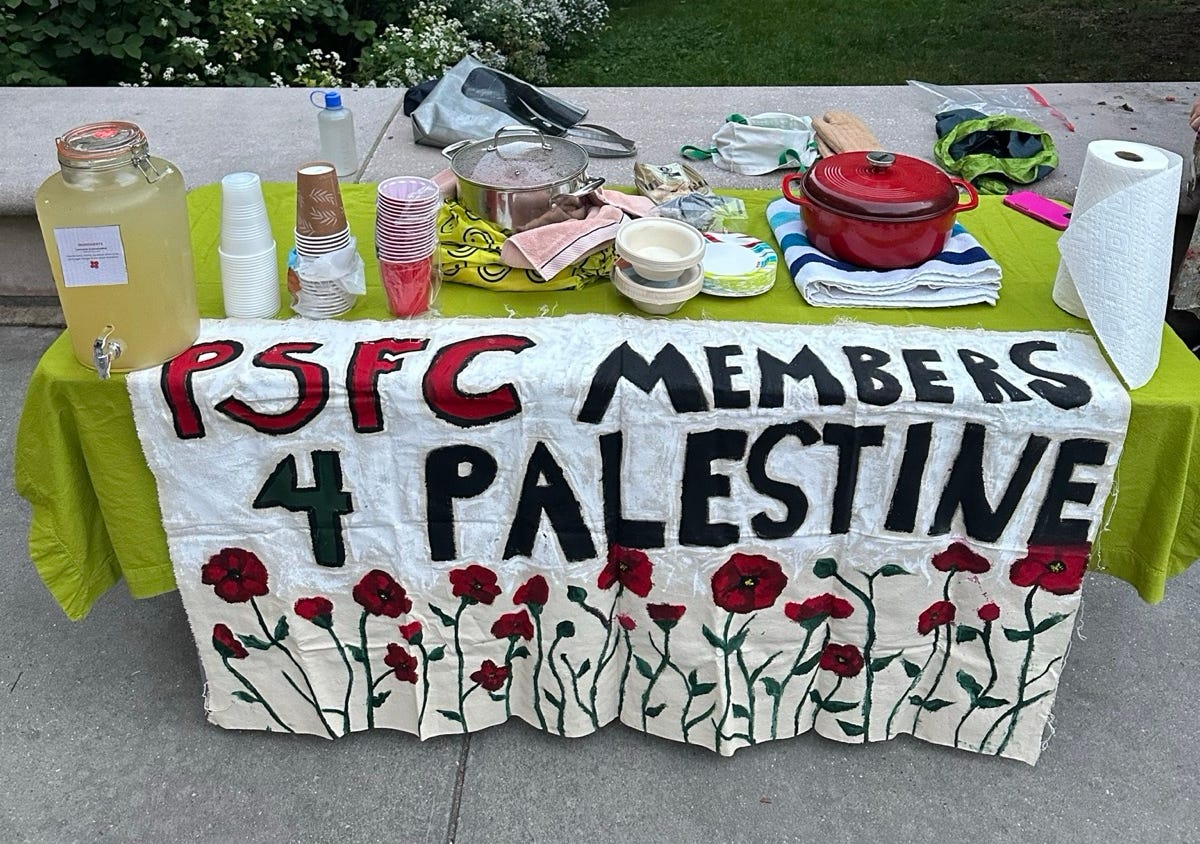
The organizing has ebbed and flowed in the last 14 years, but it picked up strongly again in 2023, following the October 7 attack on Israel by Hamas and the subsequent murderous assault on Gaza by the Israeli government. In the fall of 2023, a multigenerational and multiracial group of Coop members came together to form Park Slope Food Coop Members for Palestine (PSFC4Palestine.org). The group has been active and growing ever since. Passionate about the Coop and social justice and horrified by Israel’s ongoing genocide in Gaza, PSFC4Palestine members have been a regular presence outside the coop and at membership meetings. They have produced literature (“The Olive Press”, “Express Checkout”) and sponsored several teach-ins on the subject of BDS (Boycott, Divest, Sanction.) They have collected over 3,500 signatures from Coop members on a petition supporting the boycott. Their activism has focused not just on a boycott of Israeli goods, but on increasing democracy and political awareness at the Coop in general.
The issue of Coop democracy has come increasingly to the fore over the past 12 months. The paid staff has long argued that the Prospect Park Picnic House, where the Coop generally holds its monthly membership meetings, is not large enough to accommodate a discussion about a controversial issue like the boycott. However, the General Coordinators have claimed they were unable to find a large enough venue that was willing to hold a meeting where that discussion would happen. Since the Fall of 2023, several large venues backed out of hosting a potential meeting after receiving threatening messages suggesting that such a meeting could erupt in violence. In response, PSFC4 Palestine argued that, in an organization of over 16,000 members, hybrid meetings (where some members would be physically present and others would be online) were the only way large numbers of members could be involved in decision-making. The General Coordinators fought that proposal tooth and nail, postponing any discussion of the proposal for many months, even though during the pandemic membership meetings were held online without difficulty. In October 2025, the Coop’s Board of Directors voted to implement hybrid meetings which began this past February.
There will actually be two important votes happening at the meeting on May 26th. The first will be a vote on restoring a simple majority vote for decisions on boycotts. Some background is required to understand this. In 2016, at a contentious general membership meeting, a simple majority vote was taken to change a long-standing rule that Coop decisions are made by a 50% plus one majority. Specifically, it was decided that, in the case of boycotts only, a 75% majority is necessary. This Supermajority proposal, first publicly raised by one of the Coop General Coordinators, was clearly directed at preventing the possibility that a vote supporting a boycott of Israeli goods would ever pass. The first vote on the May 26th agenda will be on the proposal to restore the simple majority for boycotts.
The second vote will be on the boycott itself: whether or not the members of Park Slope Food Coop will choose to align themselves with the large majority of the world, with international law, with the Palestinian people. You can find PSFC4 Palestine’s slide presentation of their proposal here.
The long struggle at the Coop over BDS has been covered, often mockingly, by media from The New York Times to the New Yorker to the New York Post. Local and national politicians have routinely weighed in on the Coop’s decisions. The decision on May 26th will surely draw attention from mainstream and independent media as well as from political actors around the country. It’s no accident that Israel’s supporters have fought so hard for the past 17 years to prevent the boycott from coming to a vote. The saga of the Coop’s General Coordinators’ attempts to squelch pro-Palestinian voices and avoid straightforward boycott votes is a close-to-home example of how Zionist forces have been undermining democratic practice and processes even in “progressive”, “alternative” institutions where a commitment to democratic process is, or at least should be a core value.
Because the decision will hinge on how many people turn out for the meeting, we strongly urge any of our readers who are members of the Park Slope Food Coop to attend this historic meeting and vote for the boycott.
Click here for PSFC4 Palestine’s guide to everything you need to know about the meeting.
- Judy Loebl & John Gordon are long-time members of the Food Coop and members of Park Slope Food Coop Members for Palestine.
Community Faces Off with ICE and NYPD at Wyckoff Hospital
- Video posted by New York Immigration Coalition
Art of Movement Building — Paul Stein
Local Action asked me to answer two questions: What are you doing with your art? Why are you doing it?
Since the age of seven when I started taking music lessons, music has been my art. My primary instrument is the piano accordion, and I also play the melodica and the claviola, which are both related free reed keyboard instruments that are blown into. When I was growing up in the 1950’s, the piano accordion was extremely popular in the US, but I am one of only a tiny number of accordion students from the ‘50’s who are still playing it today. At an advanced age, I improved my skills by studying with Dr. William Schimmel, one of the most acclaimed US accordionists.
Although over the years, I have performed in a wide range of styles and venues from classical music at Lincoln Center to ethnic music at street fairs and private parties to holiday music at community dinners to standards and klezmer at weddings and bar/bat mitzvahs, since I retired from my career as a public sector lawyer in 2010, I have spent most of my energy providing musical support with my accordion (both alone and with other musicians) for demonstrations, vigils, marches, picket lines, and social events that support progressive causes. For about 30 years before I retired, I also played for progressive causes, but much less often than now. In 2011-2012, I was a fixture around Occupy Wall Street with a band I named The Occuponics, and since 2012, I have been a member of The Filthy Rotten System band, which sprang out of the Catholic Worker movement. The accordion is uniquely suited to protest music outdoors because it projects well and the accordionist can lead singing while playing the melody and chords and marching. Although I sometimes use a small amplifier, at protests where the police are enforcing the no amplification without a sound permit rule, I can play the accordion unamplified and still be clearly heard a distance away, unlike for example the unamplified guitar, which does not carry as far.
I do what I do because I am very upset by the lack of true justice and peace in this world and want to make the best contribution I can to fix that. Music is a universal language that brings people together, lifts their sprits, and makes them feel stronger. When I show up at a protest with my accordion, the music always gets a positive reception from the participants. Also, I believe that when music is played at a protest, it attracts the attention of passersby and makes it more likely that they will pay attention to the message of the event. So when I bring music to a progressive action, I feel I am supporting and helping to build the movement. Being a protest accordionist lifts my spirits and is a calling that I feel very fortunate to have the skills to pursue.
More videos and photos of Paul playing at protests and rallies can be found on his FaceBook page.
Brooklyn Public Library Mounts “The Warehouse” at the Bedford Branch
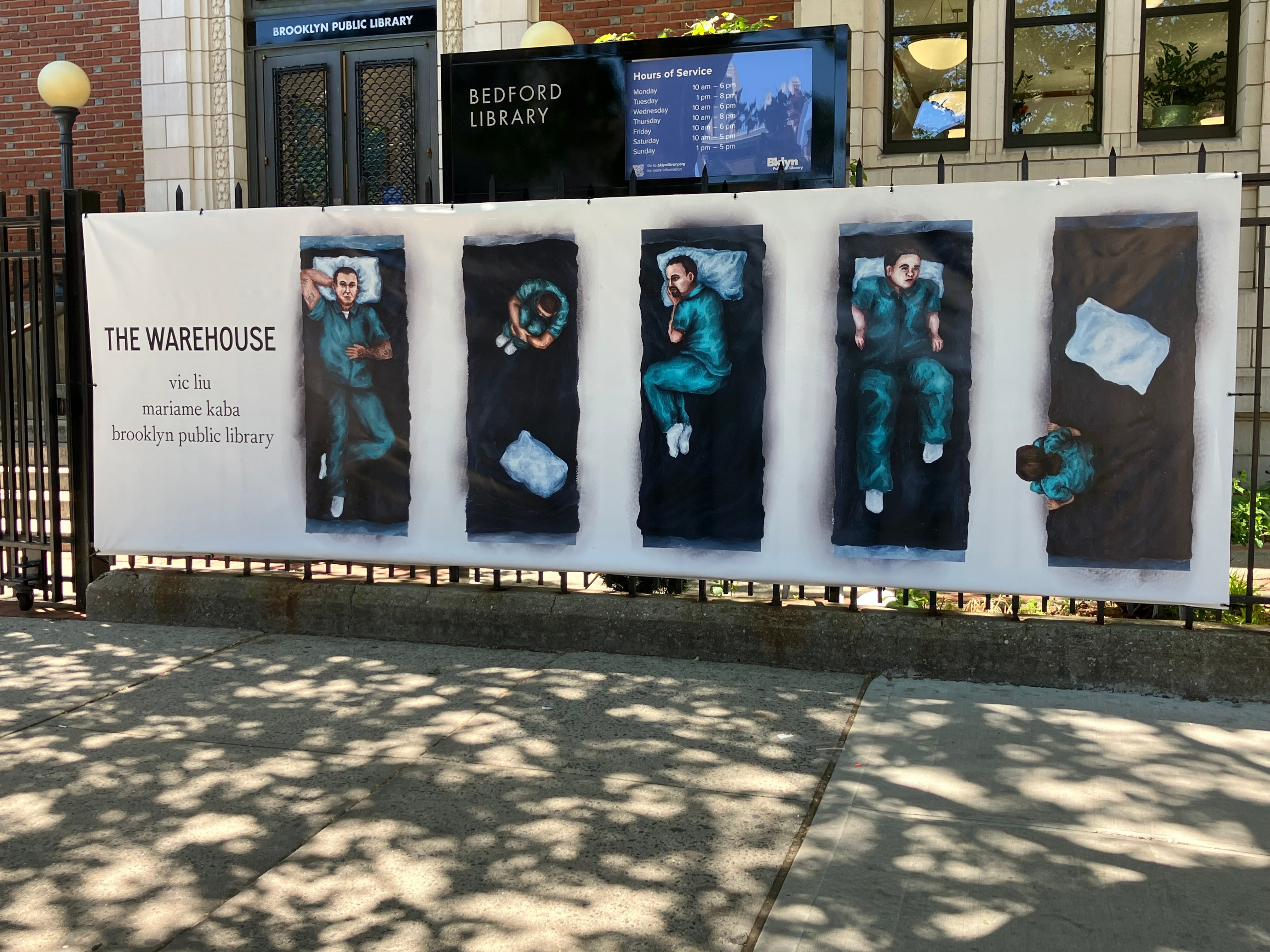
For the past year, I’ve been lucky enough to volunteer with the Brooklyn Public Library’s amazing Justice Initiatives team, who have been collaborating on a
powerful exhibition on mass incarceration at the Bedford Library (496 Franklin Ave, Brooklyn, NY 11238). According to the BPL website:
The Warehouse is a collaboration between writer and artist Vic Liu, abolitionist organizer Mariame Kaba, and Bedford Library in conjunction with BPL’s Justice Initiatives.
Inspired by Liu’s book The Warehouse: A Visual Primer on Mass Incarceration (co-written with James Kilgore), the exhibition transforms Bedford Library with two dozen new paintings. These works examine survival within prison walls, the emotional distance between “inside” and “outside,” and imagine approaches to community safety without reliance on punishment and prison.
The exhibit, which opened on April 04, 2026 and will run to June 27, 2026, has sections in both the Children’s Wing and the Adult Wing. The work in the Children’s Wing imagines “abolition on the outside: care, safety, and accountability beyond punishment.” The section in the Adult Wing features “histories and practices of resistance on the inside, grounded in lived experience.”
According to the BPL website, “A series of free public programs will accompany the exhibition at Bedford Library, including conversations, workshops, and community gatherings.”
- John Gordon
We hope that Local Action can be a vehicle to encourage collective action, help to break through the impotence and isolation many of us are feeling at this time, and contribute to building a community that makes the change we need.
If you want to find out more about Local Action, check out our About page. If you would like to contribute to future issues, please write to us at localactionnyc@gmail.com.
Local Action Team: Charlie Wertheimer, Ed Goldman, Eric Fretz, John Garvey, John Gordon, Judy Loebl, Paul Wasserman
Thanks for reading our Local Action! Subscribe for free to receive new posts and help build resistance to the authoritarian takeover of the country.
Excellent issue!